AI Semiconductor ETFs Rally as Leveraged Funds Draw Fast Short-Term Inflows
AI semiconductor ETFs are riding stronger demand for AI servers, memory, networking chips and equipment. Money is moving beyond plain ETFs into 2x and 3x leveraged products. Korean investors must weigh dollar exposure, local trading rules and short-term volatility before chasing the rally.
Partner picks
Relevant partner links for this story
A lightweight commerce block designed to add monetization without breaking reading flow.
Good fit for Korea-based visitors ready to buy.
View offerWorks well for price-sensitive gadget and desk-tool traffic.
View offerUseful for books, work tools, and international shoppers.
View offerAdvertisement
This module may include affiliate links that earn a commission from qualifying purchases. ETF와이어
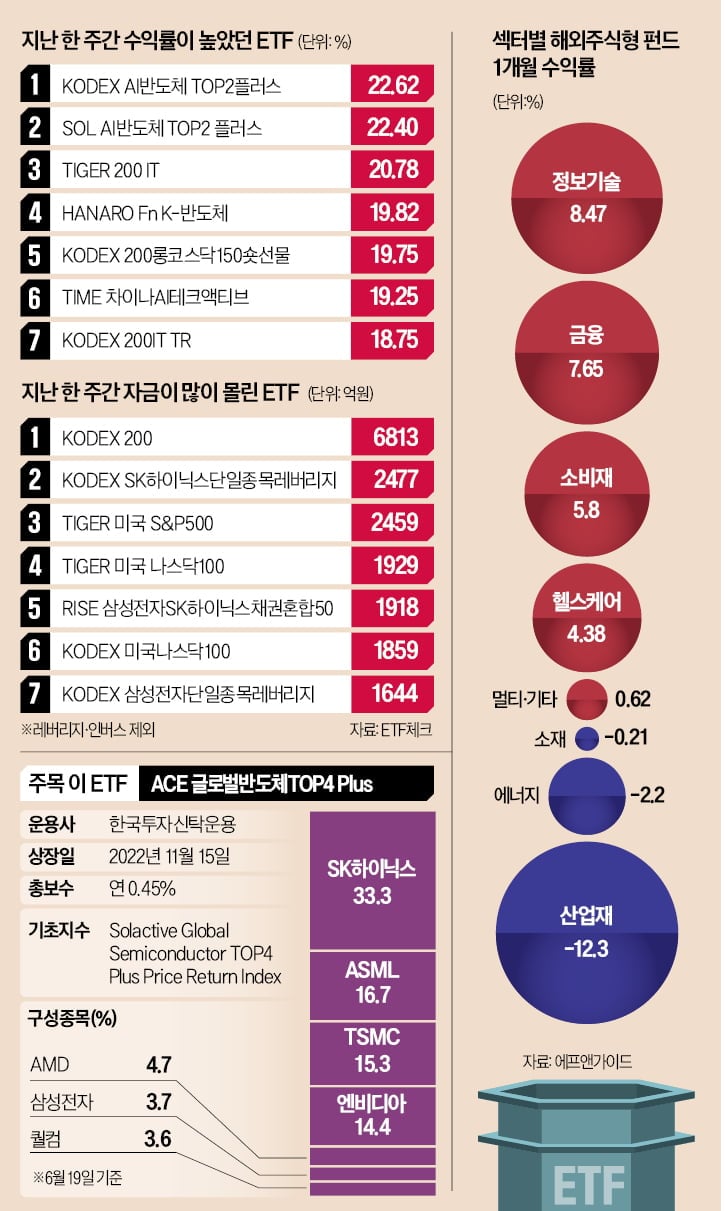
AI semiconductor ETFs have returned to the center of market attention. Spending on AI servers, high-bandwidth memory, advanced foundry capacity and data-center efficiency is feeding broad demand across the chip supply chain. The rally is no longer limited to single stocks; ETF buyers are seeking diversified exposure to design, manufacturing, equipment and materials companies.
Money Moves Into AI Chip ETFs
The main driver is the AI infrastructure cycle. Investors who do not want to select individual chip stocks are using ETFs to capture the wider semiconductor chain. Demand for GPUs, networking chips, memory and packaging equipment is rising together, making semiconductor ETFs a direct way to express an AI growth view.
Leverage Magnifies Both Sides
Leveraged semiconductor ETFs show how aggressive short-term positioning has become. A 3x product targets roughly a 3% daily gain when its underlying index rises 1%, but it can also lose about 3% when the index falls 1%. On a 1 million won position, a 3% daily swing equals about 30,000 won. Because these funds reset daily, longer holding periods can produce returns that differ from a simple multiple of the index.
What Korean Investors Should Watch
For Korean investors, the won-dollar exchange rate is a major variable. A $1,000 position equals about 1.4 million won if the exchange rate is assumed at 1,400 won per dollar, and a 2% currency move can change the won value by about 28,000 won apart from the ETF price. Leveraged and inverse ETFs also involve investor protection rules, product disclosures, brokerage limits, taxes and conversion costs. The AI semiconductor ETF rally may continue while the data-center investment cycle holds, but leverage should be treated as a short-term tactical tool, not a default long-term holding.
Partner picks
Relevant partner links for this story
A lightweight commerce block designed to add monetization without breaking reading flow.
Good fit for Korea-based visitors ready to buy.
View offerWorks well for price-sensitive gadget and desk-tool traffic.
View offerUseful for books, work tools, and international shoppers.
View offerAdvertisement
This module may include affiliate links that earn a commission from qualifying purchases. ETF와이어
Key points
- AI semiconductor ETFs are riding stronger demand for AI servers, memory, networking chips and equipment. Money is moving beyond plain ETFs into 2x and 3x leveraged products. Korean investors must weigh dollar exposure, local trading rules and short-term volatility before chasing the rally.
- Use the body and FAQ context before acting on this update.
- Compare with related issues inside the category hub.
FAQ
Why are AI semiconductor ETFs rising?
Demand for GPUs, memory, networking chips and chip equipment is increasing as AI infrastructure investment expands.
How is a leveraged semiconductor ETF different?
It targets two or three times the daily move of an index, so both gains and losses are amplified and long-term returns can diverge from a simple multiple.
What should Korean investors watch first?
They should check currency exposure, conversion costs, taxes, trading restrictions and the higher volatility of leveraged products.
Related stories

Anthropic AI ETFs Gain Attention as SpaceX Sparks Pre-IPO Demand
Pre-IPO demand that followed SpaceX is moving toward AI ETFs with exposure to Anthropic and OpenAI. BAI holds $109 million in Anthropic preferred shares and $47 million in OpenAI, about 1% of assets. T. Rowe Price Technology ETF holds $4.9 million across the two names. Korean investors need to weigh won returns, overseas ETF taxation, liquidity and private-s
Korean Semiconductor Materials ETF Rally Shifts Retail Money to Front-End Funds
The second leg of Korea’s semiconductor rally is spreading from large chipmakers to materials, parts and equipment. Several related ETFs ranked near the top in June returns. SOL Semiconductor Front-End took first place, helped by strength in PSK, VM and TES. The market views the move as an internal sector rotation.
Korea Investment Hosts 13 Global Asset Managers Including Carlyle and J.P. Morgan
Korea Investment & Securities broadened its ties with 13 global asset managers, including Carlyle and J.P. Morgan. The event took place on June 19 at 63 Building in Yeouido, Seoul. The agenda focused on expanding global investment products, improving access for Korean investors and strengthening strategic cooperation.
Partner picks
Relevant partner links for this story
A lightweight commerce block designed to add monetization without breaking reading flow.
Good fit for Korea-based visitors ready to buy.
View offerWorks well for price-sensitive gadget and desk-tool traffic.
View offerUseful for books, work tools, and international shoppers.
View offerAdvertisement
This module may include affiliate links that earn a commission from qualifying purchases. ETF와이어